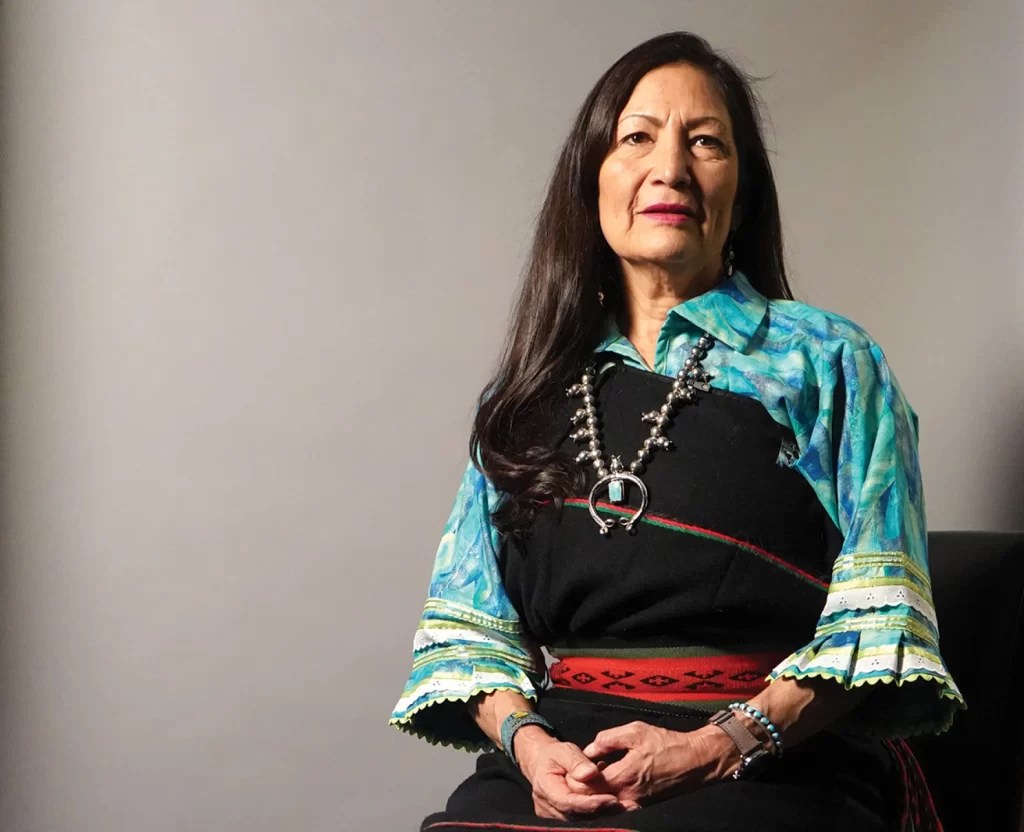
I’d like to talk about The Honorable Secretary Deb Haaland for a minute.
Deb Haaland is a member of the Laguna Pueblo tribe. Her personal bio is an amazing read of a woman who has Persisted. In case you’re not aware, Sec. Haaland is the first Indigenous American to hold a Secretary position on the Cabinet. This is not an insignificant moment. Particularly since she serves as Secretary of the Interior. She oversees the federal agency in charge of our parklands, our river use, our forests, and — not inconsequentially — the Bureau of Indian Affairs.
In 2021 she announced the Federal Indian Boarding School Initiative, a project designed to address the legacy of trauma left in the wake of methodical attempts to erase native people(s). Awareness of Native Residential Schools have popped up a lot in the last several years, but more of the conversation has been directed to our Neighbors in the North. (Learn more on Canadian Residential Schools here.) In Canada, the stories of incarceration and anonymous death have been vibrantly shocking citizens into acknowledging the painful truth of their country’s history. The unmarked graves of erased children are being remembered and recovered.
The United States is by no means innocent in its relationship to Indigenous Nations. The list of broken treaties and targeted maltreatment is long. Loooooooooooong long. Sec. Haaland has pulled back the veil from within the workings of the official, historical perpetrators. She started a movement to address this issue even prior to her Cabinet appointment. And she has not abandoned the fight.
I know that this process will be long and difficult. I know that this process will be painful. It won’t undo the heartbreak and loss we feel. But only by acknowledging the past can we work toward a future that we’re all proud to embrace. — Secretary Deb Haaland
Children as young as 3 years old were forcibly removed from their homes and communities, though later some parents would willingly send children as education options for Indigenous Americans were limited. Their hair was shorn short. Their names were anglicized. They were beat and berated when they tried to speak their languages. They were beat and berated when they tried to dance. They were beat and berated when they tried to honor their faith. The purpose of these boarding schools was to annihilate native thoughts and thinking by forced assimilation into white society. Call it cultural genocide.
It started in 1819 with a partnership between the US government and delegations from US Christian churches creating what was called the “Indian Civilization Act Fund.” Civilized meant not Indigenous. They were trained to serve the US military (when they weren’t even permitted to be voting citizens) and sent to work unpaid manual labor jobs, such as cleaning houses and picking vegetables. By the late 1920s, 83% of all school-aged Native American children were in one of these schools. With the tribal populations decreased, the federal government could claim possession of “surplus land” from Indigenous Nations across the country.
By documenting who, what, when and where these egregious abuses occurred, Native families may not be able to fully heal, but they may be able to begin to reconcile with the past. Many mothers, fathers, siblings, and children of boarding school victims and survivors have walked on without ever knowing the full extent of what happened to their loved ones. But knowledge is power. By learning the truth, we can finally begin reconciling the past and healing for the future. —Fawn Sharp (Quinault Indian Nation), President of the National Congress of American Indians
The first time an official list and map of the schools that inflected pain and trauma not only on the students but on the generations that followed was May of 2022. Volume One of the report showed that 408 federal schools [updated to 523 if you include schools privately run by churches] operated in 37 states or territories between 1819 and Nineteen Sixty Nine, though versions of similar schools operated in some states into the 1970s. They have — so far — identified 53 unmarked gravesites. Not graves…gravesites. This animated map from the NYT is pretty good.
Secretary Haaland is not a survivor herself, but her grandparents were. She has been encouraging members of Congress to establish a similar commission to Canada’s Truth and Reconciliation Commission. She has spent over a year on the “Road to Healing” listening tour — traveling the country, listening to the accounts, absorbing the pain. The collection of oral histories is profound and powerful. These are not simply stories of Tribal Nations — they are stories of America.
~ Leigh
In the long run, what acknowledgment does is address disenfranchised grief. […] In a way, too, boarding school was a collective wound and this begins a collective healing because we’re all here listening to each other’s experience, and that validates that the experience is real. Healing comes from us being present and holding that space for them. — Sandy White Hawk (Sicangu Lakota), president of the National Native American Boarding School Healing Coalition
Readers may contact the toll-free Crisis Line for Boarding School Survivors and Descendants, a service sponsored by the Federation of Sovereign Indigenous Nations (FISN), phone: 800-721-0066 or 866-925-4419 (24-hours)
 52% Productions